Self-Supervised WiFi Sensing for 3D Human Pose
Dec 2025 – present · Project page ↗
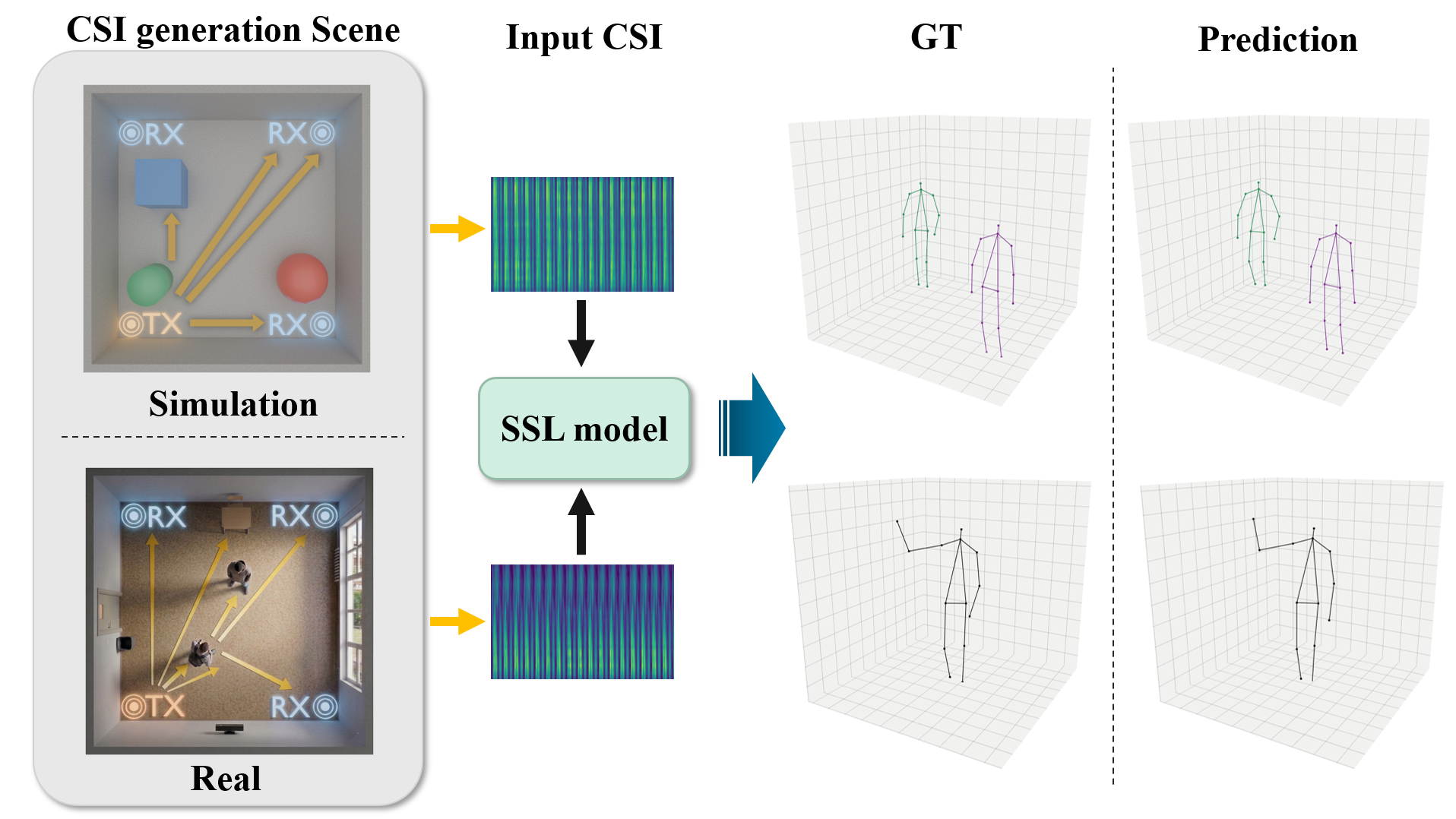
I study whether WiFi channel measurements (CSI) can recover 3D human pose without cameras. Robust WiFi pose estimation faces three bottlenecks: (i) cross-domain generalization is fragile — accuracy drops in a new room or with moved transceivers; (ii) label scalability is limited — pose labels need camera-based annotation in a few fixed-hardware rooms; (iii) CSI is noisy and hardware-dependent — flattening it into image-like 2D grids mixes its subcarrier, time, and link axes. My answer is WiFi-JEPA: self-supervised learning redesigned around CSI’s physical structure — far fewer labels, robust transfer across rooms and hardware. Accepted at ECCV 2026 [1].
Encoding WiFi CSI: axis-preserving tokenization & link masking
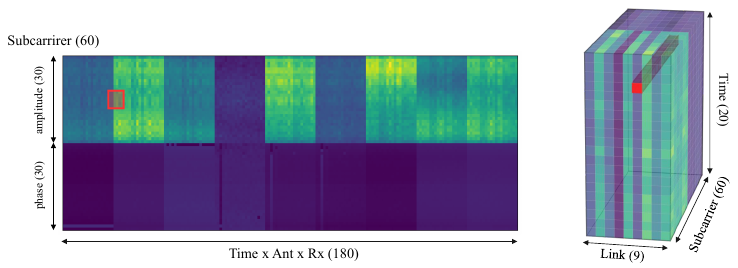
- Axis-preserving tokenization: keep the CSI tensor (C, T, L) = (60, 20, 9) — subcarriers × time × antenna links — instead of flattening it into a 2D image; each of the 180 tokens is one antenna link at one time step, not an arbitrary patch.
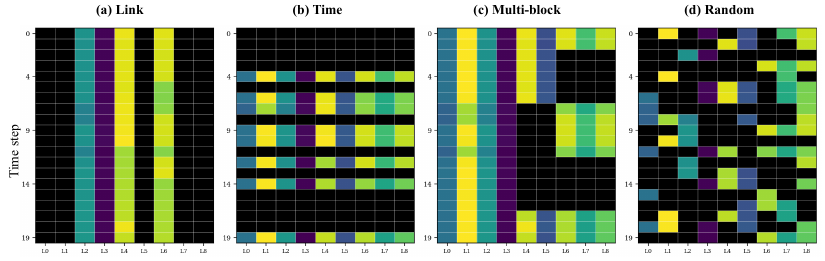
- Link masking: hide 5 of 9 antenna links entirely and predict them from the rest — the encoder must learn the cross-link spatial correlation that encodes 3D structure.
- Result: tokenization alone cuts 14.77 mm MPJPE (111.85 → 97.08) vs. a flattened-spectrogram baseline; link masking beats time, block, and random masking — 97.08 mm / 92.56% PCK@50, 8.06 mm ahead of random [1].
Ray-traced synthetic CSI (Sionna RT)
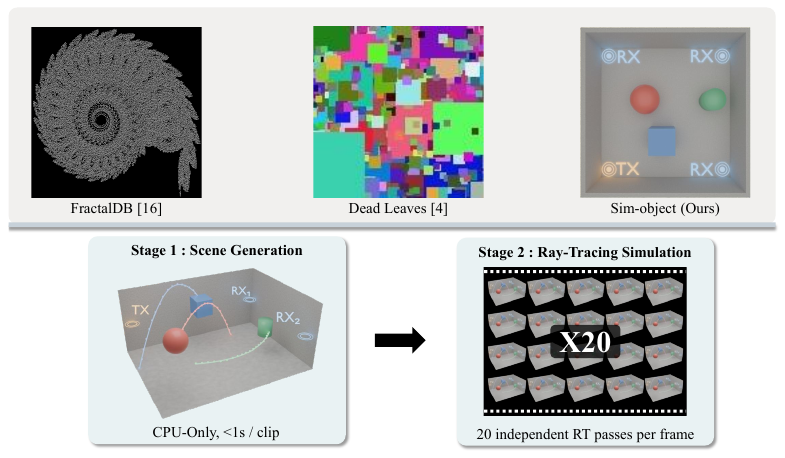
- Hypothesis: for pretraining, dynamics diversity matters more than anatomical fidelity.
- Why simulate: real CSI needs dedicated rooms, synchronized receivers, and motion capture for labels — datasets stay small and hardware-specific.
- Ray-tracing pipeline (NVIDIA Sionna RT): benchmark-compatible CSI from randomly moving geometric primitives — spheres, cubes, cylinders — with no human meshes and no motion capture; ~90K frames in ~10 GPU-hours on one RTX 4090.
- Result: real + simulated pretraining cuts multi-person MPJPE from 97.1 to 93.5 mm; primitives alone reach 100.1 mm, nearly matching real data [1].
Self-supervised learning: a CSI-native JEPA
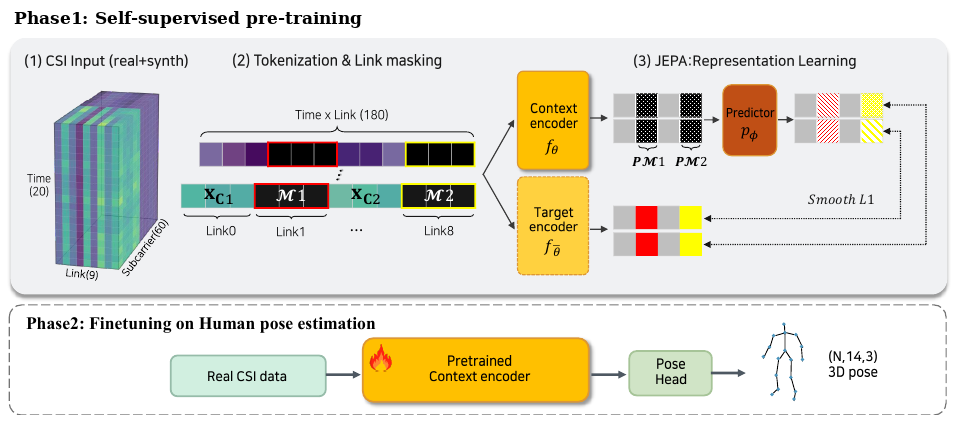 Phase 1 — self-supervised pre-training: the context encoder predicts the link-masked tokens’ latent embeddings, supervised by an EMA target encoder (Smooth L1). Phase 2 — fine-tuning the pretrained encoder with a PETR pose head.
- CSI-native JEPA: predict the masked links’ latent embeddings instead of reconstructing raw CSI — the encoder learns pose-relevant structure, not hardware artifacts.
- Comparison with SSL objectives: under the same backbone, SimMIM, MAE, BYOL, and MoCo v3 all fall below training from scratch — WiFi-JEPA is the only objective that improves it.
- End-to-end: state-of-the-art 76.8 mm single-person / 93.5 mm multi-person MPJPE (−14.7% / −12.8% vs. prior WiFi methods), with cross-environment error halved (324.2 vs. 626.4 mm) in leave-one-room-out tests [1].
Related publications
- Doeon Kim, Jungyoon Lee, Seongheum Kim, Seongsin Kim. “WiFi-JEPA: Self-supervised Learning for WiFi-CSI 3D Human Pose Estimation.” ECCV 2026.