A CSI-native self-supervised framework that learns WiFi-CSI representations by predicting masked latent embeddings rather than reconstructing raw CSI, using CSI-aware tokenization and a ray-tracing-based synthetic-CSI pretraining pipeline. It improves 3D human-pose accuracy over supervised and prior CSI baselines, including in multi-person settings.
Under Review
Physics-Bounded mmWave Sensing for Schedulable, Privacy-Preserving Human Pose Estimation
Shuntian Zheng, Hongyang He, Jiaqi Li, Xiaoman Lu, Doeon Kim, Jae-Ho Choi, Jin Zeng, Shuai He, and Yu Guan
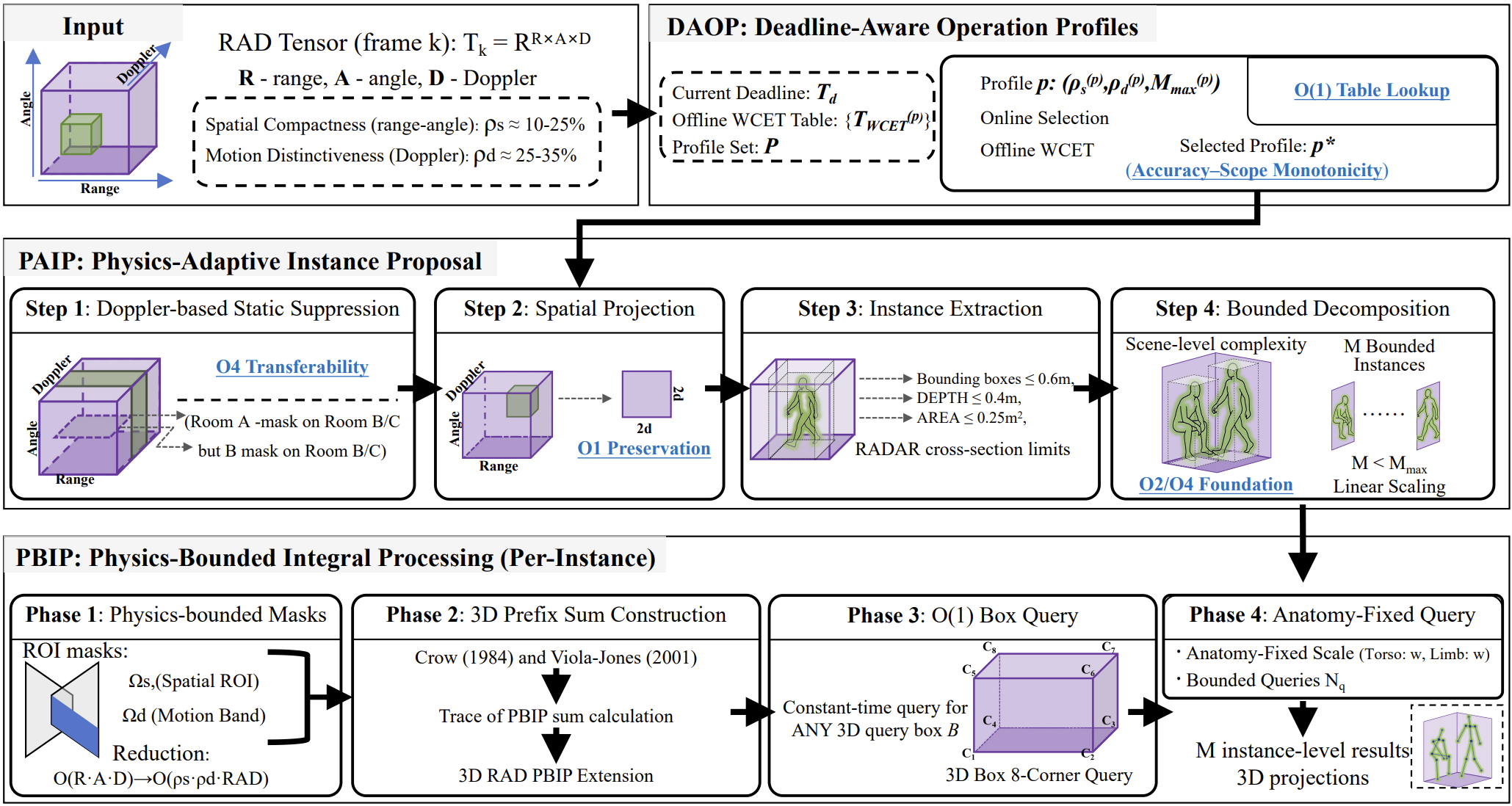
PRISM, a framework that exploits the spatial concentration of RF reflections to make mmWave human pose estimation schedulable on resource-limited edge hardware, where cameras are inadmissible and latency must be predictable. It combines physics-bounded integral processing (constant-time integral queries), physics-adaptive instance proposals that decompose multi-person scenes into bounded local subproblems, and deadline-aware operation profiles with offline-verified worst-case bounds. Across four public datasets, PRISM cuts 99th-percentile latency by 24-58% relative to deadline-missing baselines with a 0.0% miss rate, and attains the highest pose accuracy among deadline-feasible configurations.
Preprint
Physics-Aware Multimodal Fusion for 5G EMF Exposure Map Prediction
Doeon Kim, Dongryul Park, Seungyoung Ahn, Namwoo Kang, Seongheum Kim, and Seongsin Kim
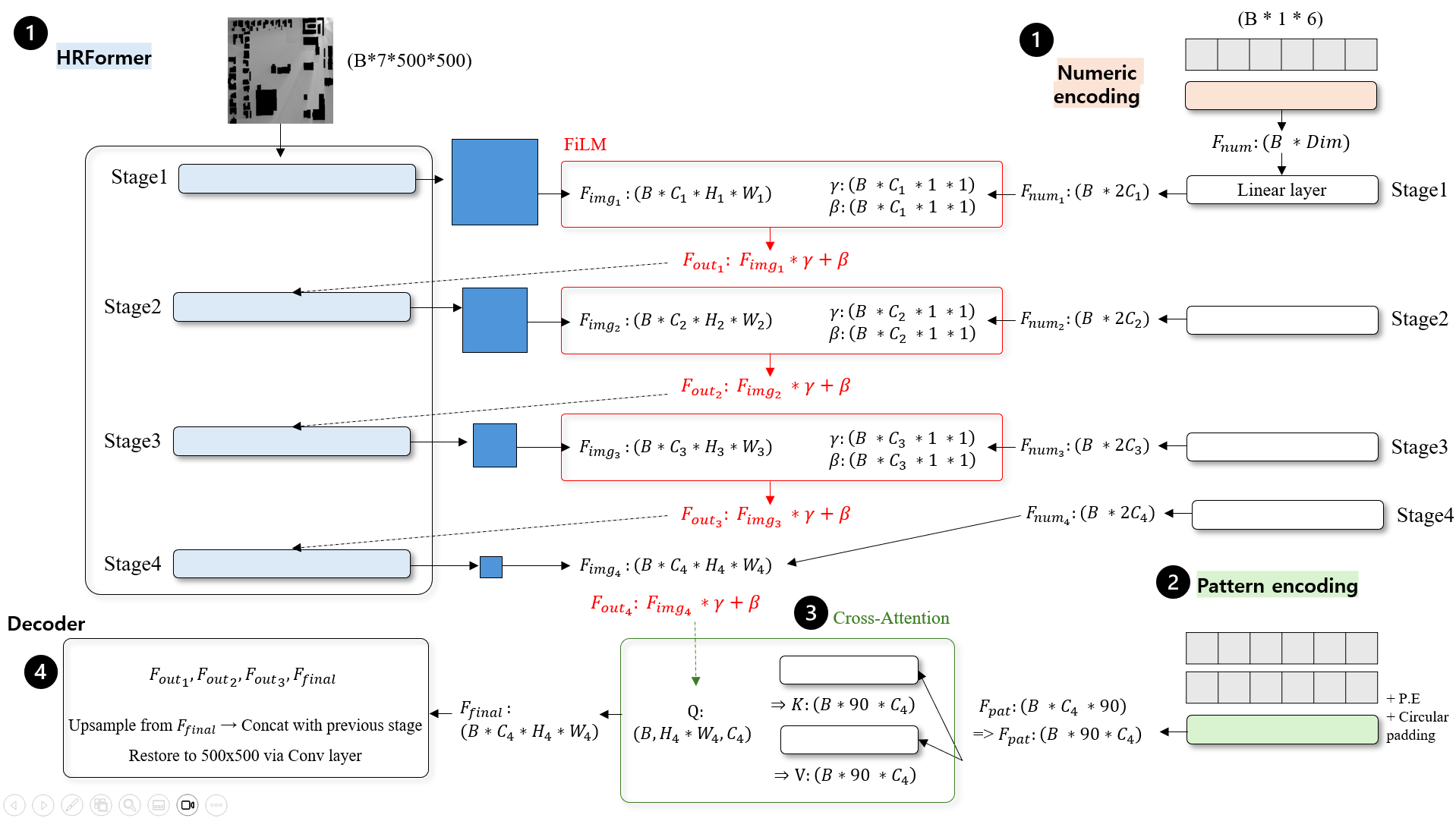
A multi-conditioned dense-prediction framework that generates urban EMF maps from building layouts and antenna configurations, using a vision-transformer backbone with feature-modulation and cross-attention conditioning and transmitter-relative spatial channels. It improves EMF-map accuracy over convolutional and unconditioned baselines.
Under Review
PAMFormer: Propagation-Aware Multimodal Pretraining for Radio Map Estimation
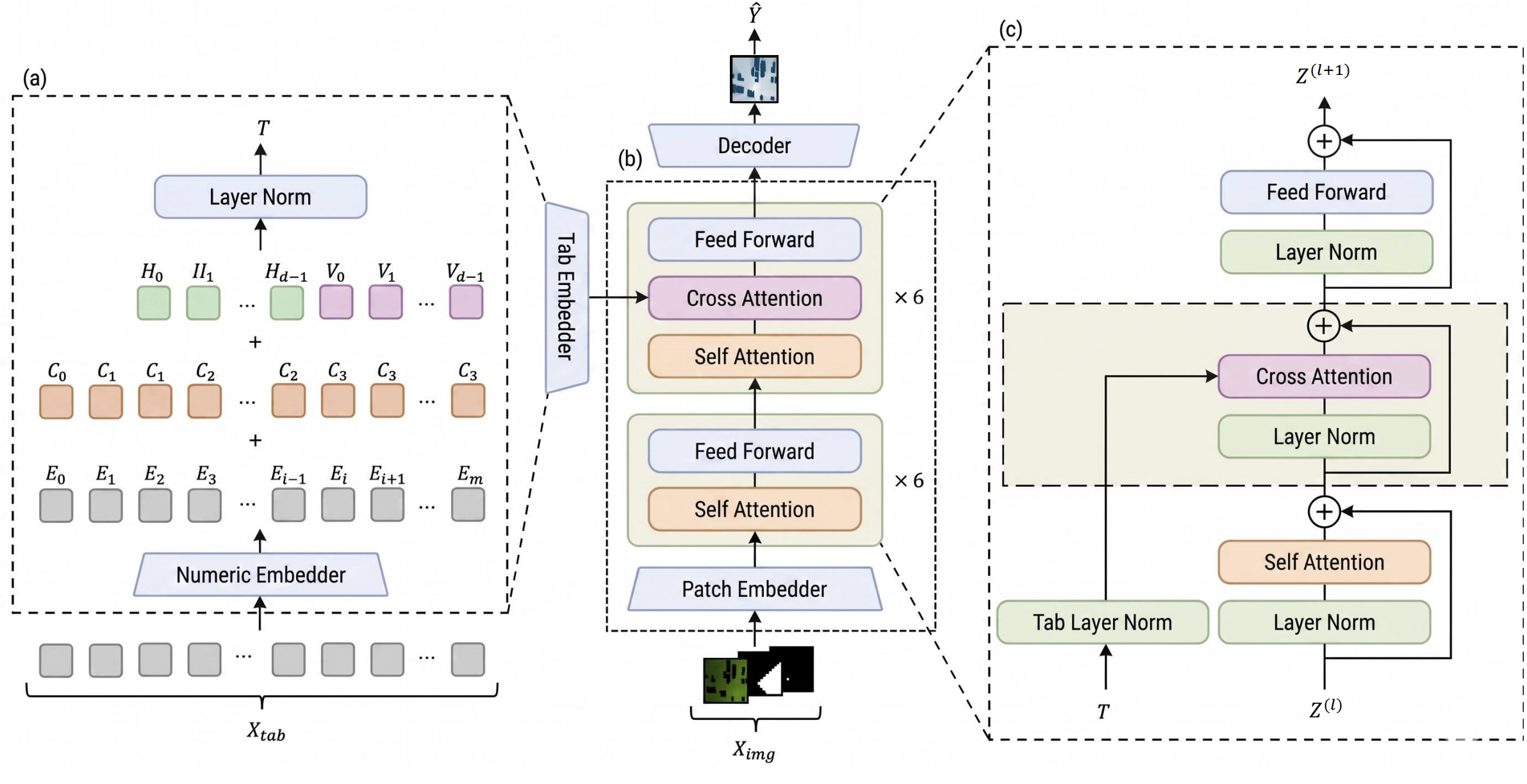
A multimodal Transformer that keeps image patches as a dense spatial stream and fuses tabular antenna metadata via late cross-attention, with masked-image and masked-tabular pretraining objectives. It achieves low error across radio-map prediction settings, outperforming convolutional and Transformer baselines.
ECCVW 2026
Generative Traffic Video Forecasting with Paired Future Descriptions via Parameter-Efficient World Model Adaptation
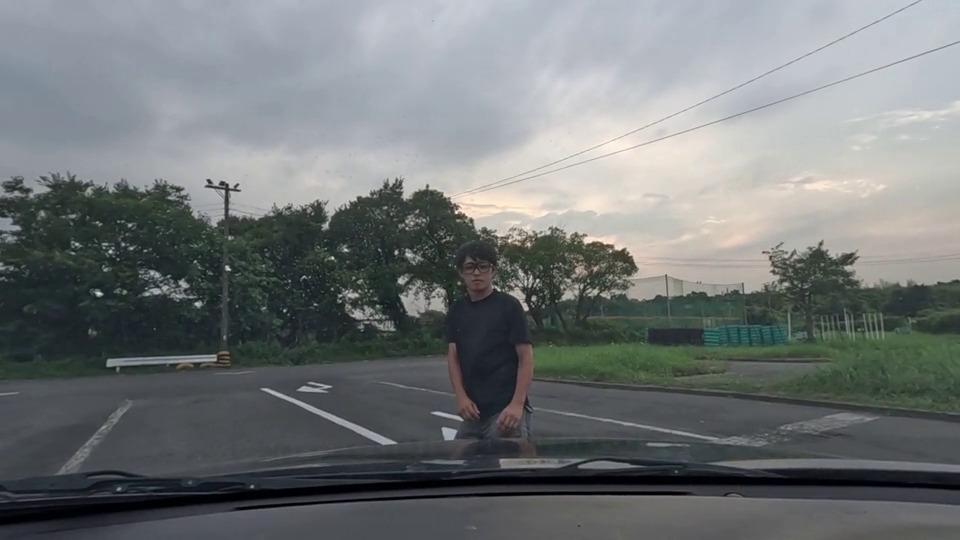
The first-place solution to the MeViS-Text track of the 8th LSVOS Challenge 2026: referring video object segmentation guided by motion expressions, including deceptive no-target expressions that must yield empty masks. The SSUPER pipeline generates full-video candidate masklets with SAM 3.1 and has three heterogeneous multimodal LLMs independently reason at every stage; a decoupled multi-agent audit of the full temporal predicate verifies target existence, and a training-data-only StyleRefiner aligns mask geometry with the MeViSv2 annotation style. Reaches a final score of 0.908 on the official challenge leaderboard.
Patent
Structure-Aware Self-Supervised Learning and Link Masking-Based 3D Human Pose Estimation System and Method Using WiFi Channel State Information
Doeon Kim, Jungyoon Lee, Seongheum Kim, and Seongsin Kim
Two multimodal fusion methods that inject transmitter physics into a pure-ViT 5G electromagnetic-field estimator: 2D spatial mapping, which encodes physical parameters as additional image-like input channels (early fusion), and token fusion, which injects them as independent tokens interacting through self-attention (mid fusion). On ray-traced urban scenes, spatial mapping reduces MAE by up to 60% and improves PSNR by 57% over an image-only baseline.
IEEE Access
Estimation of Electromagnetic Field Strength: Experiments Using Vision Transformers
Doeon Kim*, Dongryul Park*, Jinbae Seo, Hyungchan Cho, Seungyoung Ahn, Namwoo Kang, and Seongsin Kim
A systematic study of Vision Transformer architectures for predicting 5G electromagnetic-field strength from physically-informed, ray-tracing-generated inputs (building maps, antenna radiation patterns, base-station parameters). Among the compared models an HRFormer-based predictor achieves the best masked MAE of 5.45%, about a 31% error reduction over a U-Net baseline.
2024
KIIS
Tiny Object Detection Method Based on Cross Attention of Heterogeneous Feature Maps
Seungchan Kwon*, Doeon Kim*, Gyuil Lim*, Youngjun Han, and Seongsin Kim
A cross-attention module that fuses heterogeneous feature maps from detection and segmentation branches to recover fine details of tiny objects in aerial imagery. On the AI-TOD benchmark it improves Faster R-CNN from 40.03 to 43.80 mAP(0.5) and from 18.72 to 23.10 mAP(0.5-0.95).
 Physics-Bounded mmWave Sensing for Schedulable, Privacy-Preserving Human Pose EstimationIEEE Transactions on Mobile Computing (under review), Aug 2026
 Physics-Aware Multimodal Fusion for 5G EMF Exposure Map PredictionarXiv:2606.27671, Jun 2026, Jul 2026
 PAMFormer: Propagation-Aware Multimodal Pretraining for Radio Map EstimationManuscript under review, Jun 2026
 Generative Traffic Video Forecasting with Paired Future Descriptions via Parameter-Efficient World Model AdaptationAI City Challenge - ECCV 2026 Workshop (Oral), May 2026
 Structure-Aware Self-Supervised Learning and Link Masking-Based 3D Human Pose Estimation System and Method Using WiFi Channel State InformationMar 2026Korean Patent Application No. 10-2026-0102154, filed Jun. 5, 2026. Patent pending.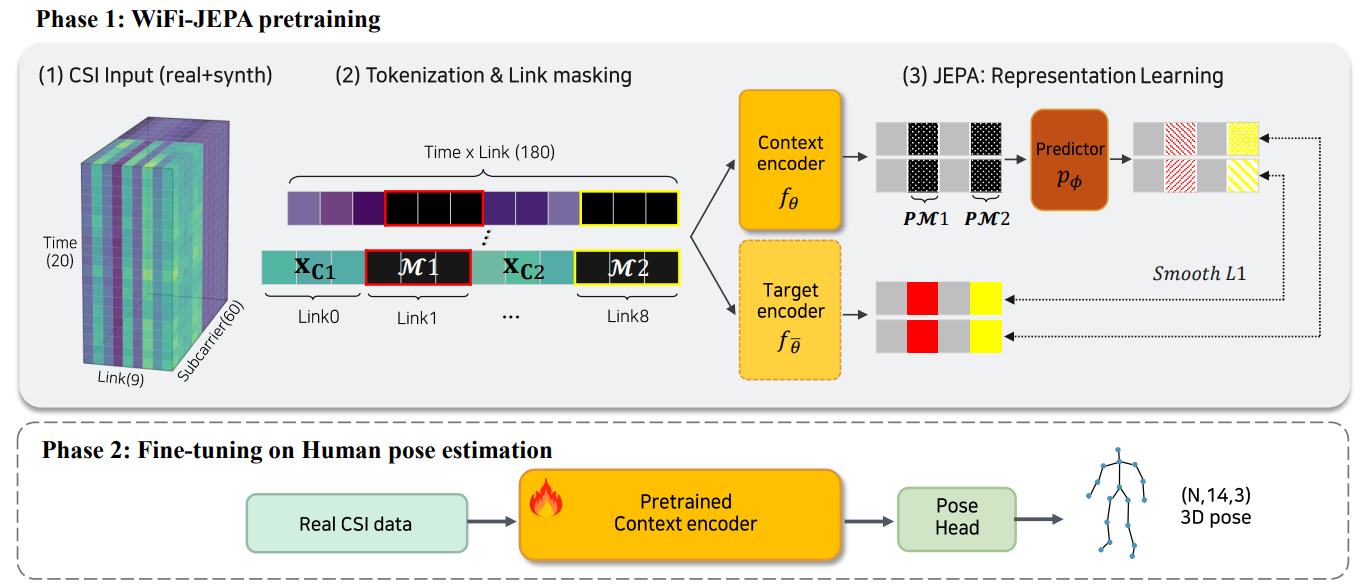

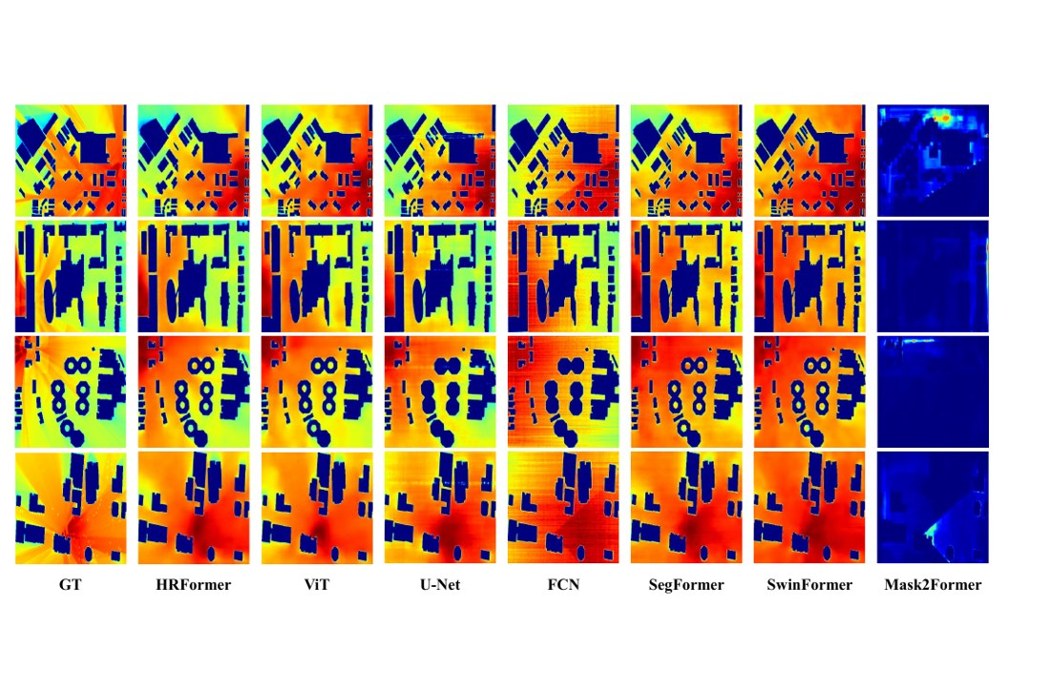 Estimation of Electromagnetic Field Strength: Experiments Using Vision TransformersIEEE Access, Oct 2025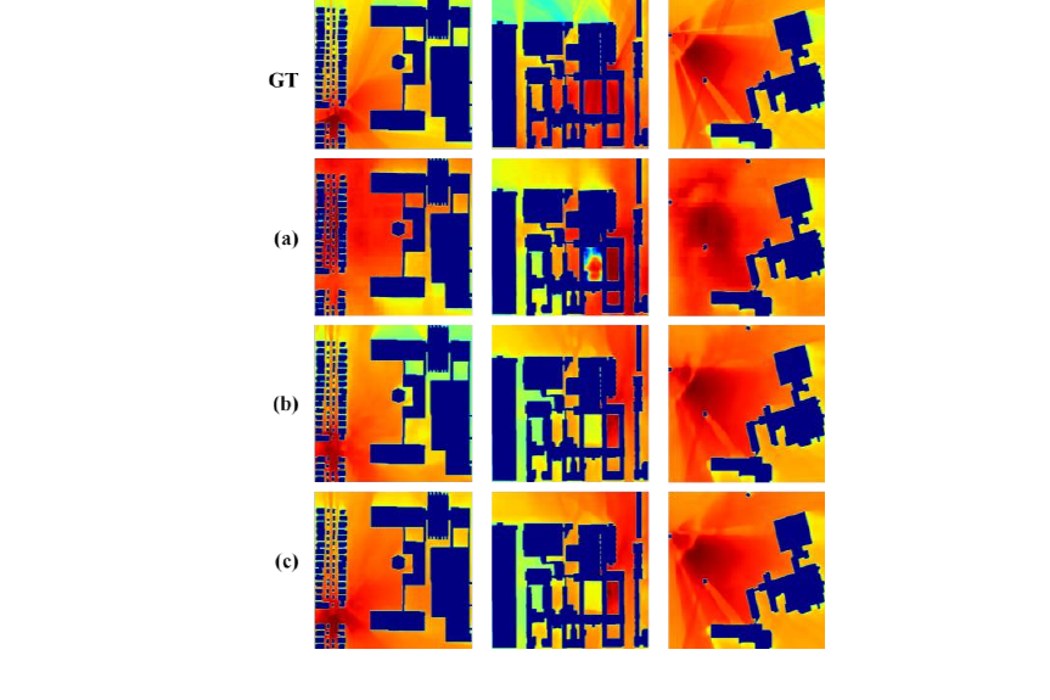
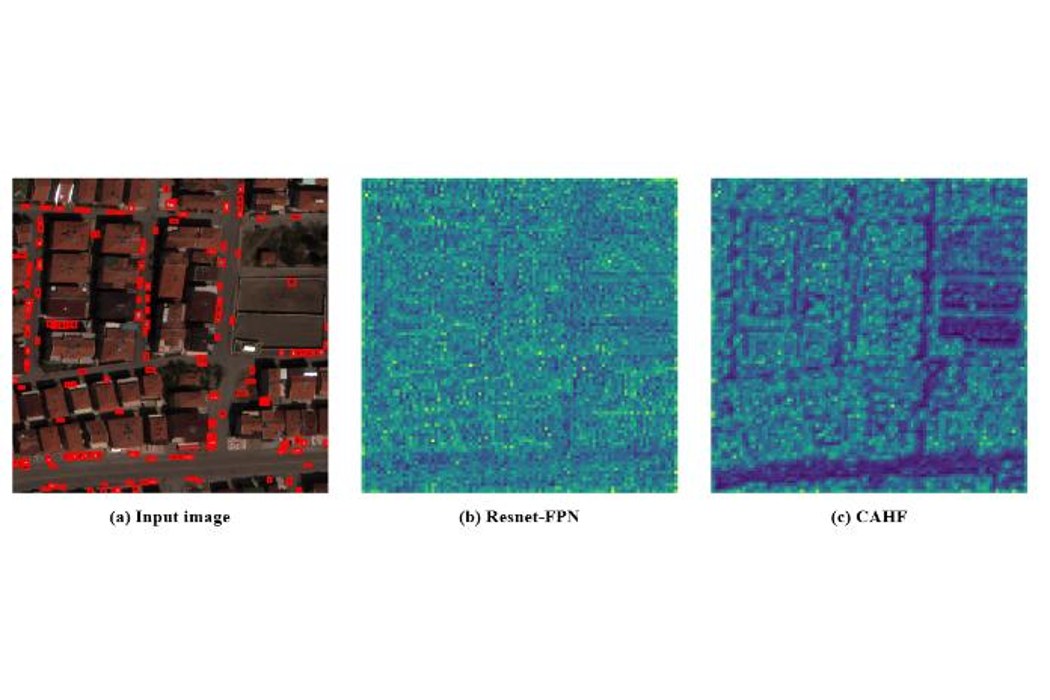 Tiny Object Detection Method Based on Cross Attention of Heterogeneous Feature MapsKIIS Autumn Conference, Gangneung, Korea, Nov 2024