Physics-Aware Multimodal Fusion for 5G EMF Exposure Map Prediction
Jan 2025 – present
Ray-tracing simulators can accurately estimate how 5G electromagnetic fields (EMF) spread across complex environments, but they are often slow and expensive. Motivated by this, I study how to predict dense EMF exposure maps directly with Vision Transformers — by feeding them the physics of propagation rather than treating the task as black-box image prediction.
Physics-aware input encoding
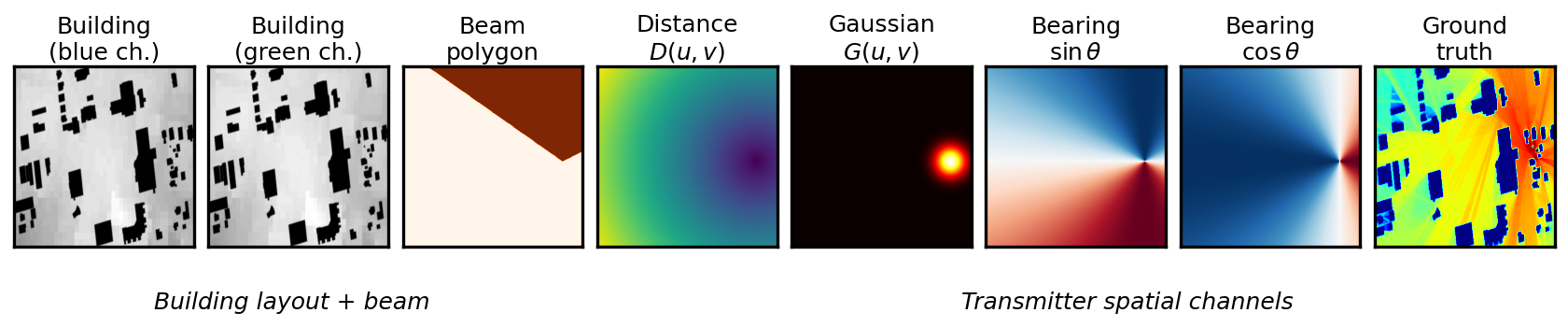 Example encoded channels — building layout & beam, plus transmitter-relative distance, proximity, and bearing maps [3].
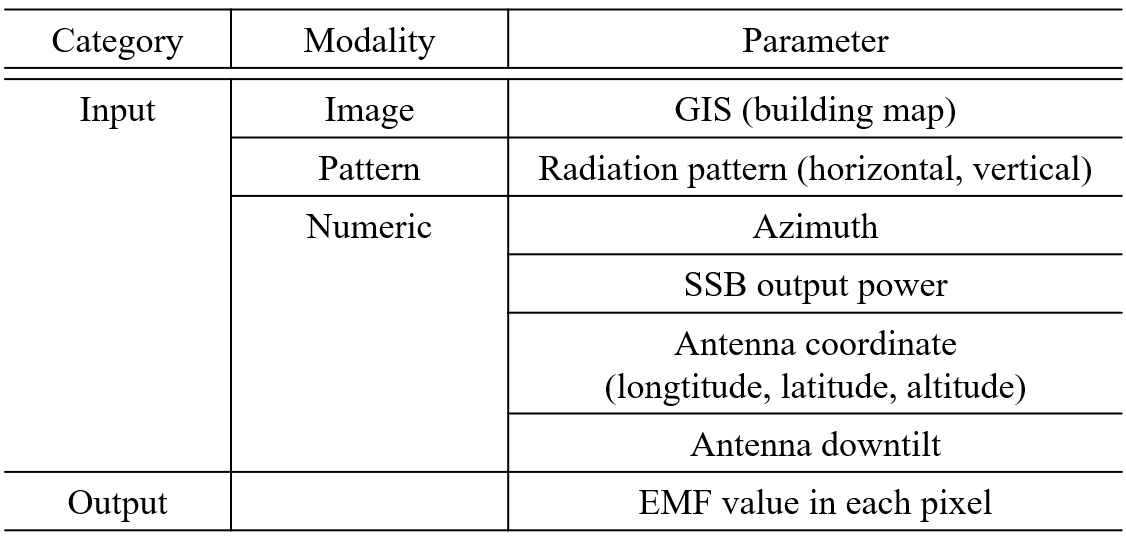
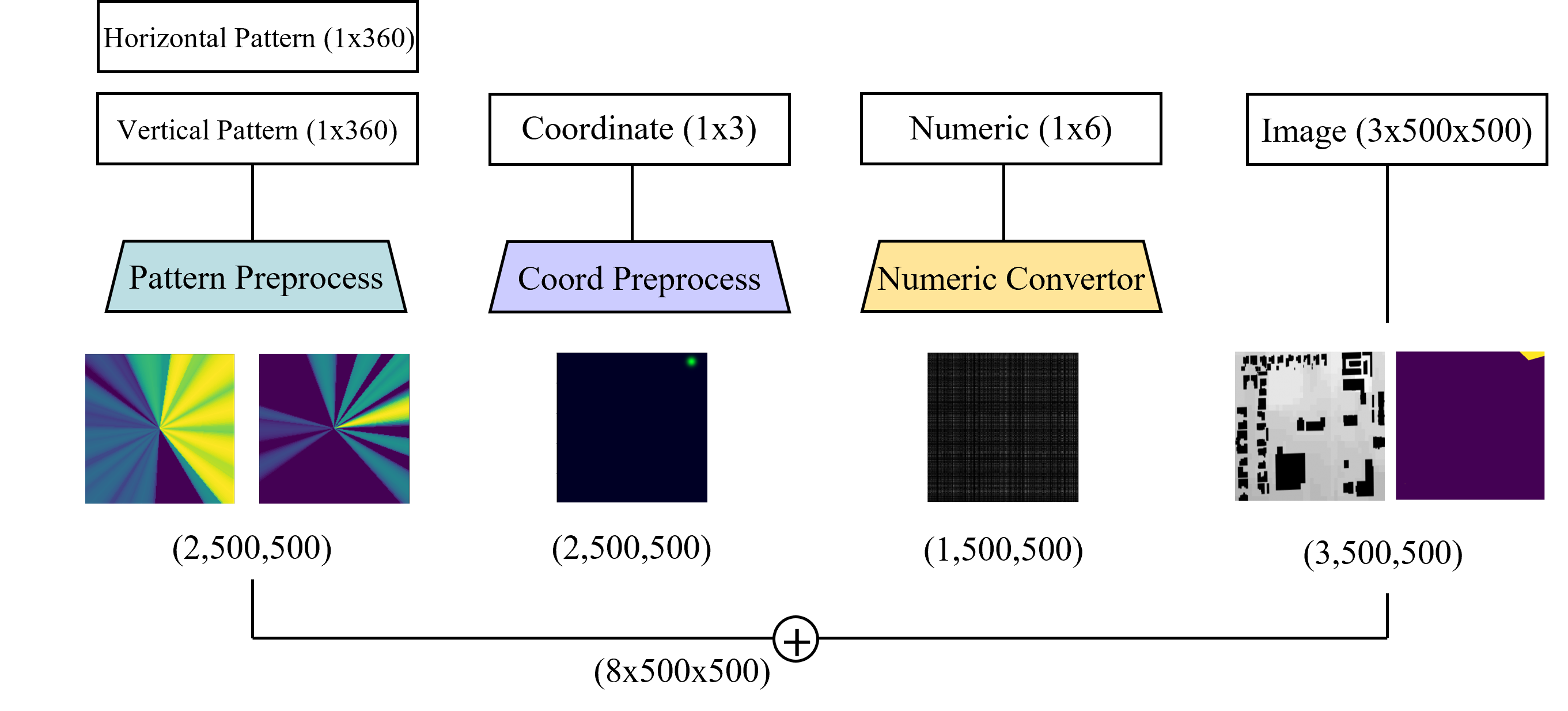
- Turned antenna radiation patterns, transmitter coordinates, numeric base-station specs, and GIS / building layouts into physically-meaningful 2-D maps stacked as ViT input channels [1, 2].
- Designed transmitter-relative spatial channels (distance, proximity, bearing from the antenna) so the model knows where the source is [3].
- Built a physically-informed multi-channel input so the network sees the same variables a deterministic propagation model would [1].
Fusion and conditioning of physical modalities
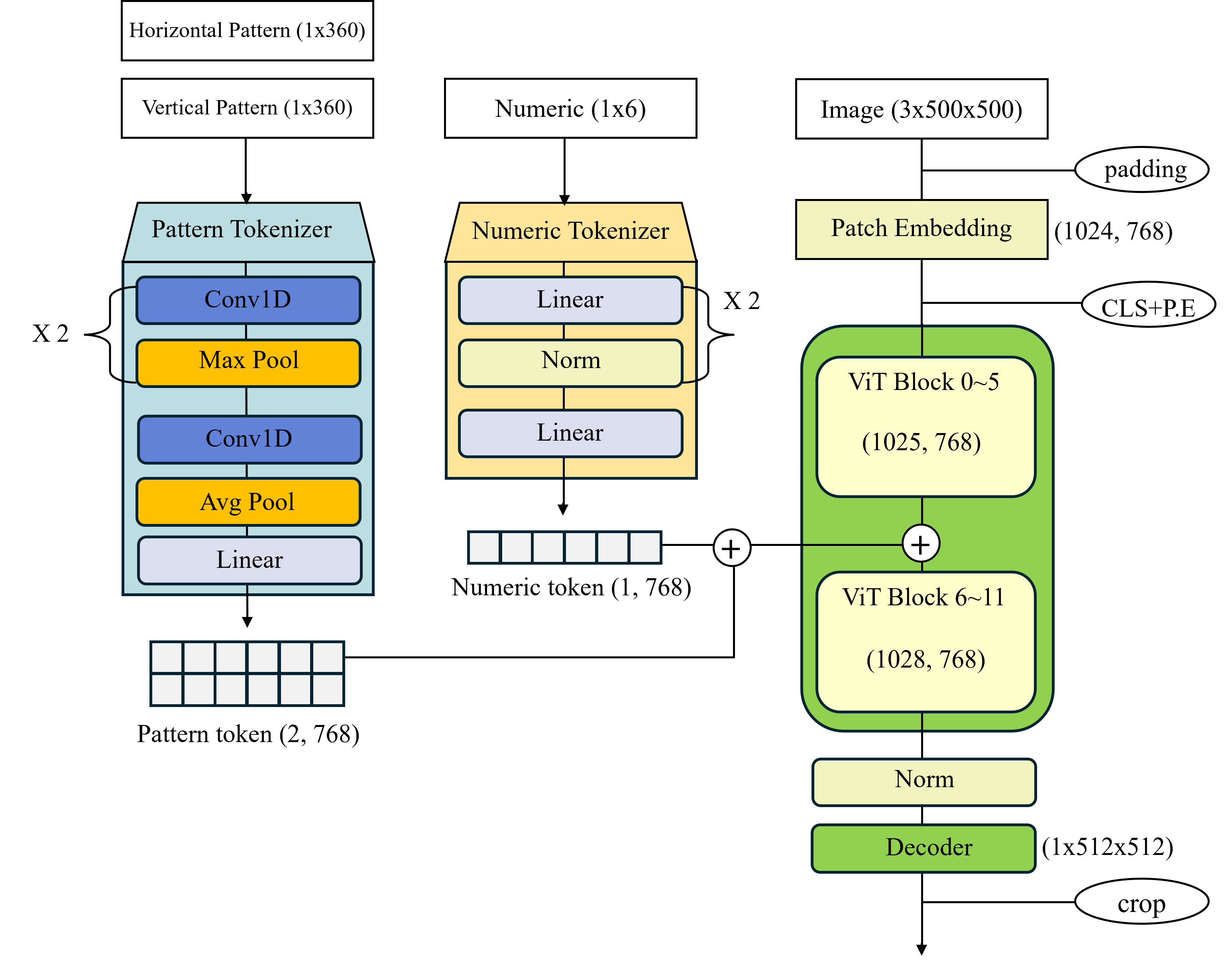
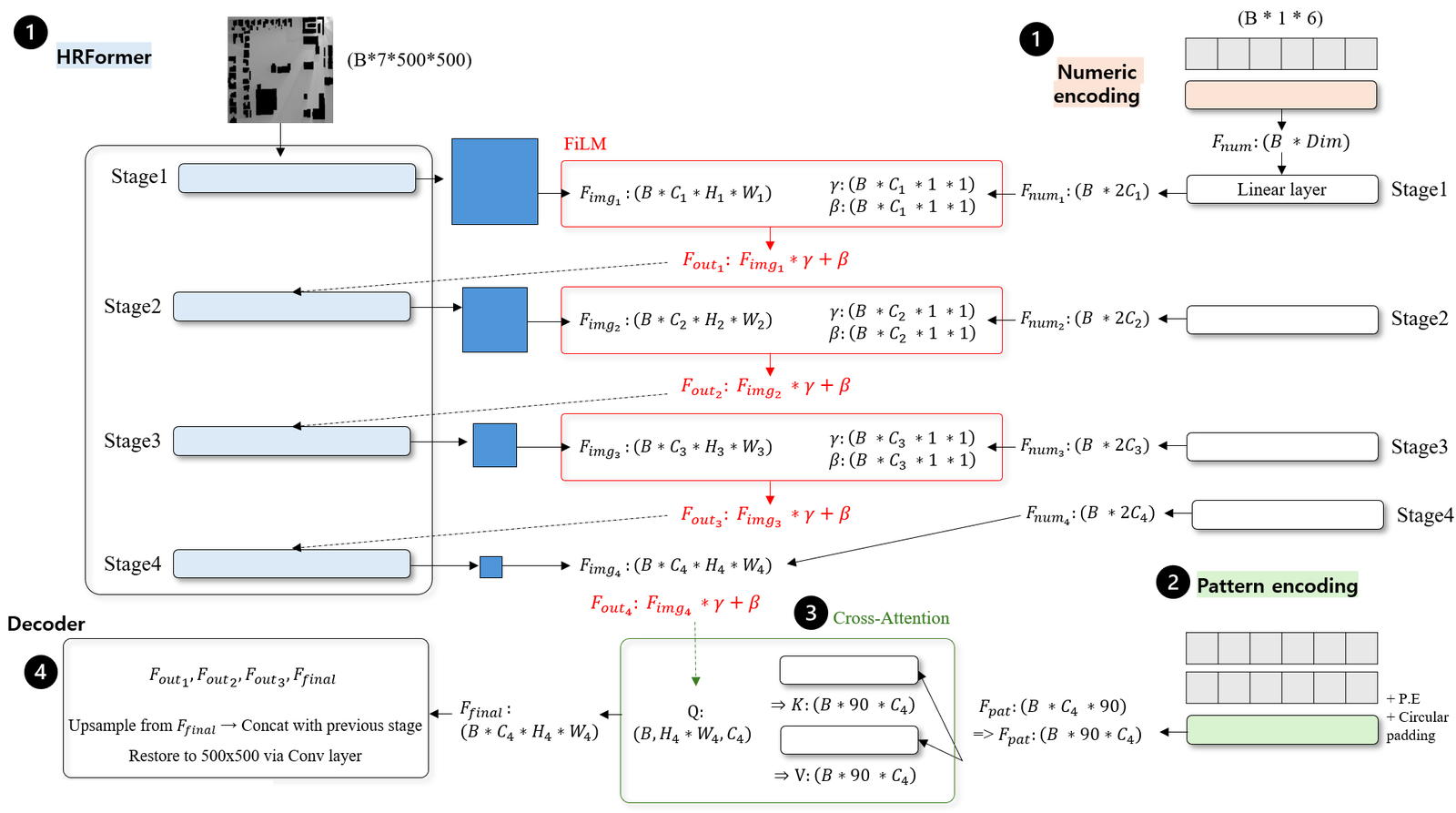
- Token fusion: converted radiation patterns and numeric antenna parameters into tokens and fused them with image tokens inside the Transformer [2].
- Spatial early fusion: projected physical variables into 2D maps and stacked them with image channels to preserve spatial alignment [2].
- Feature-level conditioning: used FiLM to inject scalar antenna parameters into backbone features and cross-attention to fuse radiation-pattern tokens with spatial features [3].
- Compared early fusion, token-level fusion, and feature-level conditioning to analyze how different physical modalities should interact with visual representations [2, 3].
Benchmarking & comparative analysis
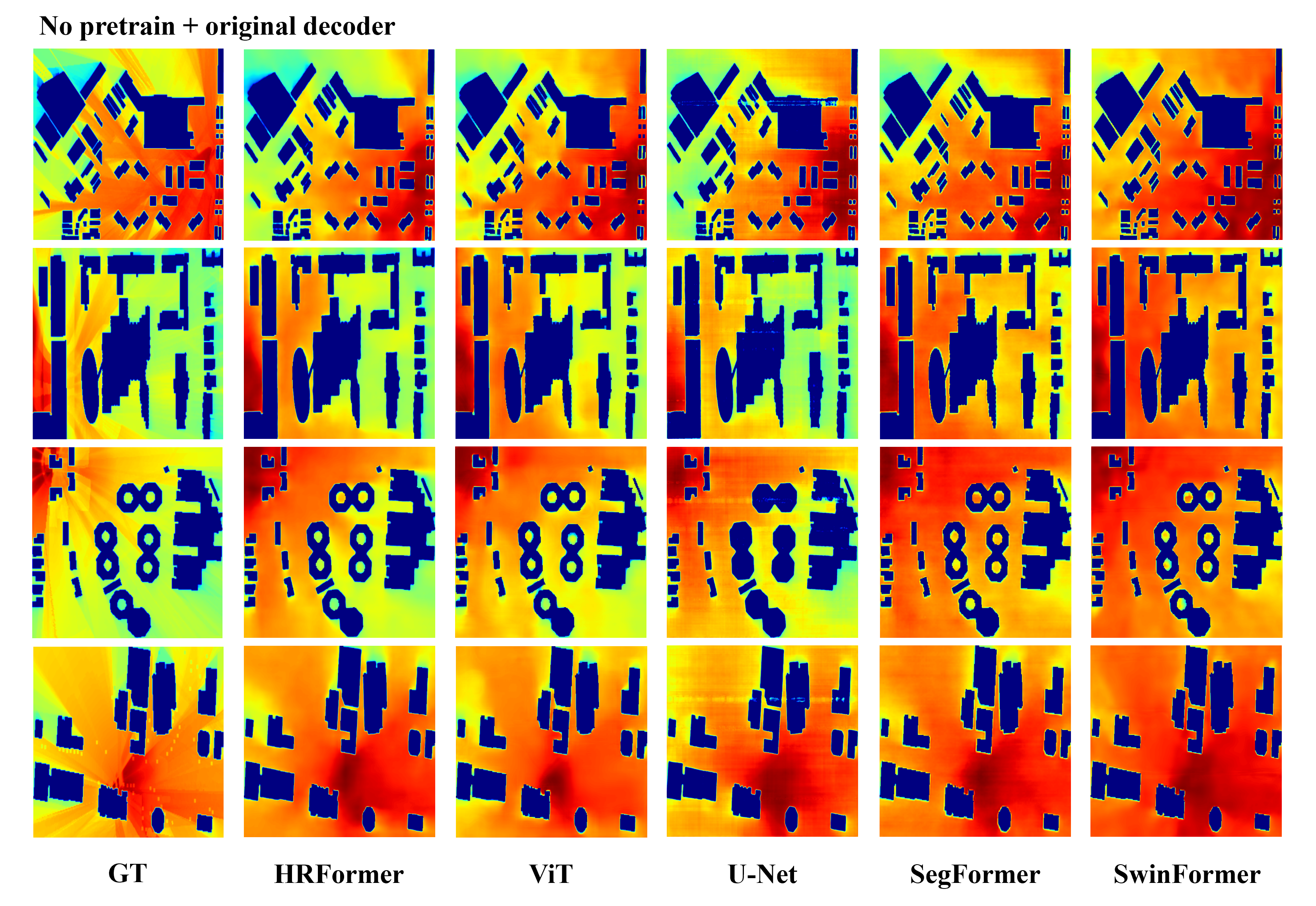
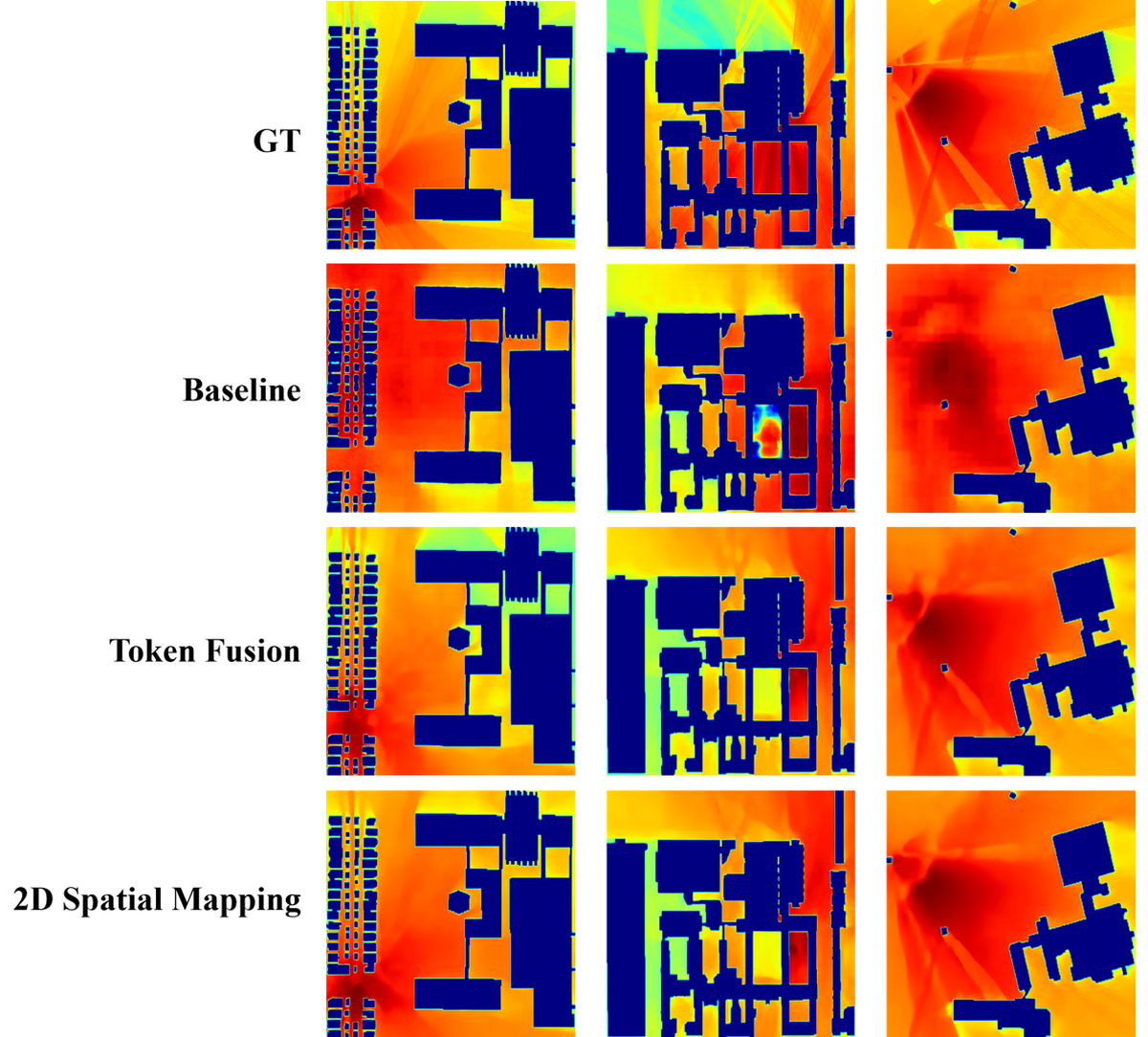
| Model | MAE (%) ↓ | PSNR (dB) ↑ | SSIM ↑ |
|---|---|---|---|
| IEEE Access [1] — standard CNN / ViT architectures | |||
| U-Net | 7.92 | 21.41 | 0.90 |
| ViT | 6.00 | 20.74 | 0.89 |
| SegFormer | 5.86 | 21.26 | 0.89 |
| Swin Transformer | 5.69 | 22.15 | 0.90 |
| HRFormer | 5.45 | 22.39 | 0.91 |
| CEIC [2] — own protocol · multimodal fusion · ImageNet-pretrained (*) | |||
| ViT* (token fusion) | 4.00 | 25.46 | 0.93 |
| ViT* (2D mapping) | 2.00 | 28.33 | 0.94 |
[1] reports masked MAE, [2] reports MAE (both shown as %); * = ImageNet-pretrained. Absolute PSNR / SSIM follow each paper's own evaluation protocol, so [1] and [2] are not a controlled side-by-side benchmark.
selected qualitative and quantitative results [1, 2]
- Benchmarked CNN and Vision Transformer architectures for dense EMF prediction, identifying HRFormer as a strong high-resolution backbone [1].
- Conducted controlled ablations to quantify the contribution of spatial channels, FiLM conditioning, radiation-pattern cross-attention, and loss design [3].
- Multi-metric quantitative analysis (MAE, RMSE, PSNR, SSIM, Hotspot IoU) and qualitative EMF-map inspection [1, 3].
Related publications
- Doeon Kim, Dongryul Park, et al. “Estimation of Electromagnetic Field Strength: Experiments Using Vision Transformers.” IEEE Access, 2025.
- Doeon Kim, Seongsin Kim. “Multimodal Physical Data Fusion using ViT for 5G Electromagnetic Field Estimation.” CEIC, 2025.
- Doeon Kim, Dongryul Park, et al. “Multi-Modal Conditioned High-Resolution Transformer for Urban Electromagnetic Field Map Prediction.” arXiv, 2026.
- Hyunwoo Choi, Doeon Kim, Seongsin Kim. “Multimodal pretraining for radio-map estimation.” Under review, 2026.
- D. Park, S. Ryu, et al. “5G Base Station Electromagnetic Field Strength Estimation Method in Complex Hotspot Area using Deep Learning.” IEEE EMC+SIPI, 2024.